Project · bracelets
The fishtail paracord bracelet
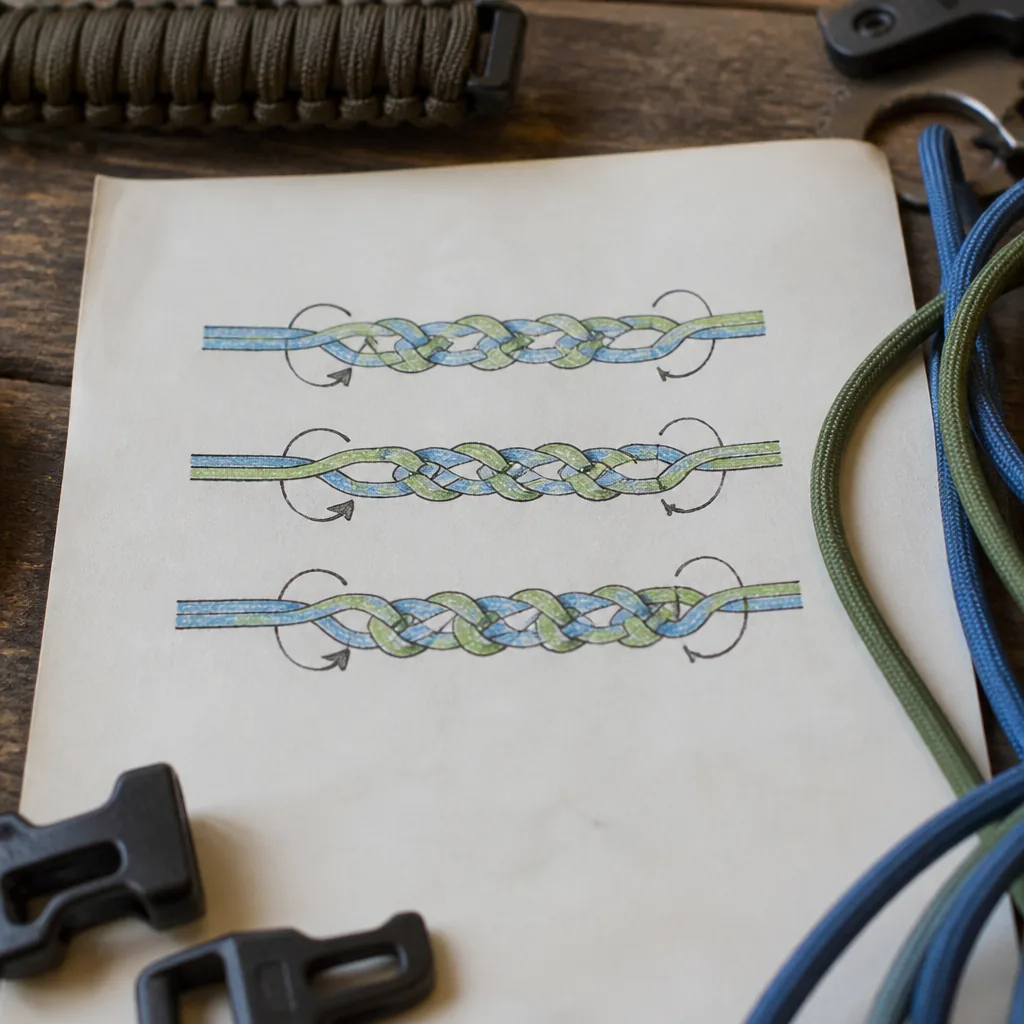
If the cobra bracelet is the paracord classic, the fishtail is the quiet favourite of people who actually use their bracelet. The weave is flat against the wrist, uses roughly half the cord for the same length, and, because the strands interlock rather than stack in knots, it unravels in seconds when you need cordage in a hurry. For a deployment-first bracelet, this is the weave.
Why choose fishtail
- Low profile: no raised knot spine; it disappears under a cuff or a watch.
- Cord efficiency: about 45–50 cm of cord per cm of bracelet, versus 70–80 for a cobra.
- Fast deployment: pick one strand free and the whole band falls open.
- Naturally symmetric: the alternating pattern self-centres: beginner tension mistakes are more forgiving than in cobra.
Materials
Two colours of 550 cord, about 1.5–2 m each, a side-release buckle or shackle, scissors and lighter. Same wrist-measuring math as the cobra tutorial: wrist circumference + 3 cm ease sets the buckle-to-buckle core length. Two contrasting colours make the pattern obvious while you learn, and hide nothing once you have.
The weave, step by step
Set the core and thread the first U
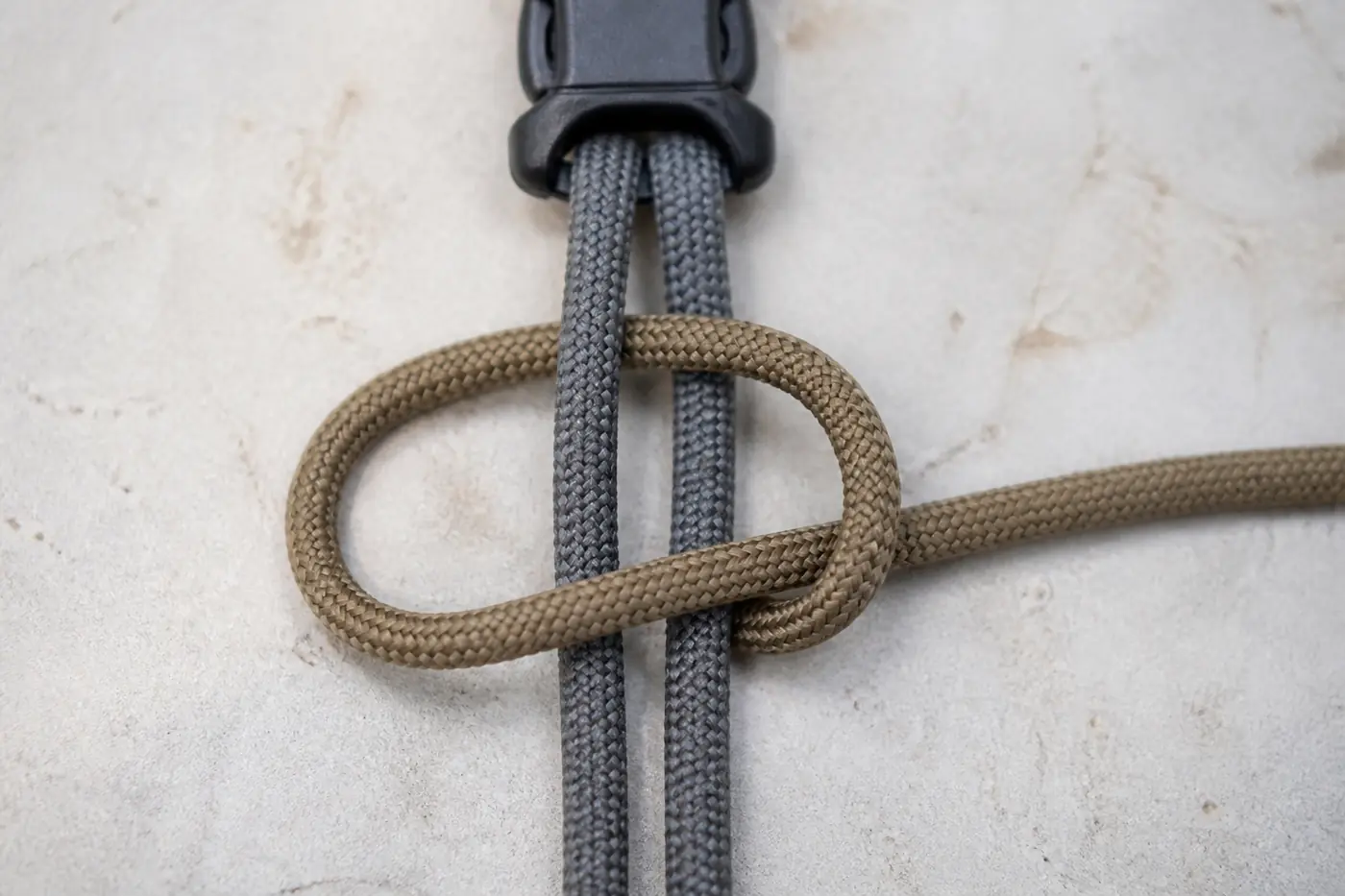
Mount the two core strands between buckle halves exactly as for a cobra bracelet. Take the left working cord and form a "U" over the front of the core: down the left side, under the bottom, back up the right. Take the right cord and mirror it: down the right, under, up the left. The two Us cross behind the core.
Interlock each new U through the last
Form the next U with the left cord, but pass it through the loop of the previous U before pulling it snug against the core. Mirror with the right cord through its opposite loop. Every new U locks the previous row: this interlocking, not friction, is what holds the weave together, which is why it deploys so fast when you deliberately unlock it.
Alternate, tension, square
Left, right, left, right, each U snug against the last, each pulled with even pressure so the two edges stay parallel. The pattern reads as a column of stacked chevrons. Stop one U short of the far buckle and let the final row close the remaining gap under tension.
Finish
Turn the band over, pull the working ends to locate their exit points, cut to 4 mm, melt and press into the back of the weave, the same clean finish as the cobra. For maximum deployability, skip the melt on the final tails: a whipped finish or a simple tucked end keeps the band able to unravel fully.
Field note: because the fishtail unzips so easily, check your final row before wearing it hard: if the last U is loose, the band can start unravelling at the buckle. A discreet stitch of gutted core through the final row, removed and re-tied in seconds, is the insurance policy.
Where the weave travels next
The same interlocking pattern scales up: watch bands, rifle slings, dog collars (with the sizing advice in our collar tutorial), and the ever-popular keychain family. It pairs beautifully with a lanyard knot termination when the band becomes a strap for a light or compass. Weave one in two colours, and you will never mistake which side of the pattern you left off on.
A note on expectations: the fishtail's flat face shows cord quality more than the cobra's knotted spine does: cheap cord with a loose sheath looks fuzzy under the crossings after a few weeks of wear. If your first fishtail goes fuzzy, that is a cord-buying lesson, not a weaving fault. Honest 550 holds the pattern crisp for years, which is also why the fishtail is the weave to choose when the bracelet is a gift: it reads as fabric, not as survival gear.
The fishtail weave holds flat against the wrist and consumes roughly half the cord of a cobra of the same length, which matters when you are counting metres before a trip. The same habits that make a flat band lie cleanly, reading a label, checking gauge, and testing a small sample first, carry over to cord work, and the page on yarn labels, gauge and a first project at weaving a flat band walks through that groundwork. Start with a short practice length before committing a full bracelet's cord.