Paracord 101
What is paracord?
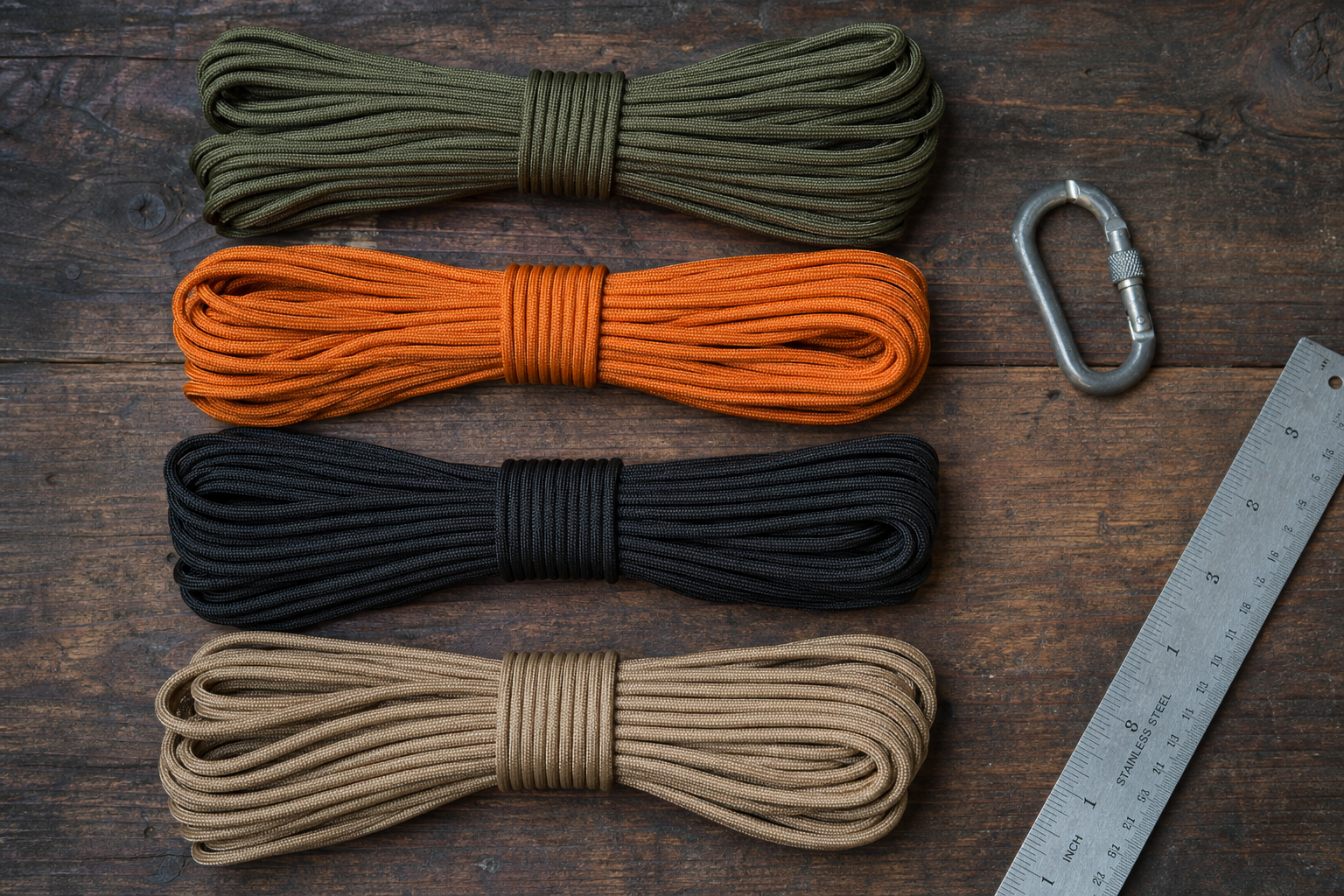
Paracord (short for parachute cord) is a lightweight nylon rope of kernmantle construction: a braided sheath (the mantle) protecting a core of parallel strands (the kern) running the length of the cord. That two-layer design is the whole secret. The sheath takes abrasion and gives the cord its smooth, knot-friendly handle; the core carries most of the load. Cut a length open and you will find seven two-ply strands in standard 550 cord: each one usable on its own as thread, fishing line or sewing repair.
From parachute risers to workbench
The cord earned its name in the Second World War, where it suspended load lines from parachute canopies. Soldiers who jumped with it quickly found quieter uses: boot laces, rifle slings, gear ties, fishing line pulled from the core. When surplus cord hit the civilian market, the craft followed, and by the 2000s the woven "survival bracelet" had turned a military line item into one of the most popular hobby materials in the world. Today the terms paracord and 550 cord are used almost interchangeably, which is convenient but not strictly accurate: see our types and sizes guide for the full family.
Anatomy of a strand
- The sheath: 16–32 woven nylon picks that protect against abrasion and UV. Tighter sheath weaves (higher pick counts) resist snagging and fraying better.
- The core: seven strands in true 550 cord, each twisted in two or three plies. They provide roughly 70 percent of tensile strength.
- The math: "550" is the nominal minimum breaking strength in pounds (about 250 kg) for Type III cord under laboratory conditions.
Those inner strands are what make paracord a field material rather than just a craft cord. Gut a foot of 550 and you gain fishing line, sewing thread, snare material, dental floss in a pinch; the outer sheath keeps working as a thinner, still-strong tube.
Field note: breaking strength is measured on a new, dry, unknotted cord in a lab. A knot reduces real strength by 20–50 percent, moisture costs a little more, and age plus UV exposure quietly takes the rest. Plan loadings at a fraction of the label number, working load limits of 10:1 are the norm in ropework for a reason. For anything life-critical, use climbing-rated rope, not paracord.
Why paracord won the outdoors
A spool of paracord solves problems that no single-purpose tool covers. It is light enough that twenty feet disappears into a pocket, strong enough for ridgelines and gear hoists, supple enough to hold fine knots, and cheap enough to cut without agonising. It accepts dye, holds a melted end, and survives weather that rots natural fibre. Few materials scale from keychain fob to improved shelter without changing chemistry.
The craft side matters too. Because the cord holds shape under tension, it weaves into dense, durable structures: the cobra bracelet, the fishtail band, wrapped handles, collars, pouches. Weaving is not just decoration, a cobra weave is essentially a long, adjustable friction splice, which is why a bracelet can be unravelled in under a minute when you need the cord.
What paracord is not
Paracord has stretch (roughly 30 percent elongation at break in the core), which makes it poor for applications needing zero give: precision rigging, slacklines, tree-slack rescue hardware. It is nylon, so it absorbs water and loses a little strength when saturated, and it melts: open flames and friction-heavy fast rappels are not its habitat. And it is not rated for life-safety climbing. Respect those edges and it remains the most versatile three millimetres you can carry.
Where to go next
New to the cord? Our suggested path: learn what the type numbers mean, stock a sane starter kit, practise the three basic weaves, and finish your first cobra bracelet in an evening. After that, the knot library and the project shelf are yours.
Further reading, off the cord
Two pages our readers open once the tarp is up and the knots are tied.
- visual astronomy observing guide, for the hours after the ridgeline is tensioned and there is nothing left to do but look up.
- histoire du folk et de la soul, a French account of the popular music that grew through the same post-war decades that pushed surplus cord out of the parachute loft and onto civilian workbenches.
Paracord and swords rarely share a shelf, but both reward the same habit: reading construction before trusting the object. A sheath braided over parallel core strands tells you how a cord stretches and where it fails, just as a blade's profile, tang and heat treatment tell you how it was forged and how it should be kept. Readers who want that same close-reading approach applied to edged weapons can spend a while on typology and materials, a page that walks through European sword forms, forge practice and long-term care. The method transfers: name the parts, note the material, then decide what the thing can actually take.
Cord is not chosen in a vacuum. The sheath count, the core strand number and the fibre type all come from a specification written before anyone ties a knot, and that specification travels through suppliers, stock levels and delivery times. A page on how a material gets specified, how a material gets specified, traces how buying habits shifted after 2020 and what that means for the small hardware and cord orders a maker places. Read it alongside the construction notes above if you want to know why the same 550 label can cover cord that handles very differently.