Buyer's guide · hardware
Paracord bracelet buckles, compared
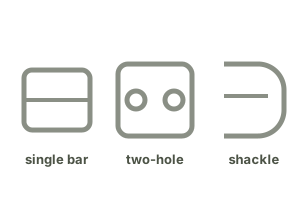
The buckle is the most consequential 5 grams of a paracord bracelet. It sets how the bracelet feels, how it opens, how much cord the design wastes, and whether you can get it off with cold fingers. Three families dominate, and each has a clear best use.
Single bar (ladder) buckle
A flat plastic bar with a ladder of rungs. The cord wraps directly around the bar (no plastic housing at all) which makes it the thinnest, lowest-profile option and the one purists like: nothing to break, nothing to rattle, and the full bracelet is cord. The costs: adjustment is by re-weaving (you choose rungs, not millimetres), and opening means unthreading one end. Best for: minimalist fishtail bands and woven-in-place designs.
Two-hole side-release
The workhorse: a moulded male-female pair, the cords threading through two slots on each half. Curved versions match the wrist and dramatically improve comfort on wider bracelets. Opening is one-handed, one-squeeze; the decisive advantage for a bracelet you actually deploy, as discussed in the survival bracelet guide. The costs: bulk at the closure, and the plastic is the bracelet's weakest link: buy quality (the hardware section of our buyer's guide lists what to check). Best for: almost everyone, almost every cobra bracelet.
Shackle
A steel bow-shackle with a threaded pin: the closure borrowed from sailing rigging. It is the strongest option by far, looks superb against the weave, and the threaded pin can double as an emergency screwdriver. The costs: weight, cost, and the pin: fine threads with numb or gloved fingers are their own small adventure; loctite or an o-ring keeps the pin honest. Best for: gear-first bracelets meant to be deployed as cordage, king cobra bands, and wrists that break plastic.
The comparison, side by side
| Single bar | Two-hole SR | Shackle | |
|---|---|---|---|
| Comfort | excellent (low profile) | very good (curved) | good (noticeable weight) |
| One-hand opening | no | yes | with practice |
| Strength | cord-limited | buckle-limited | far above cord |
| Adjustability | rung steps | weave time | thread depth |
| Weight/cost | minimal | light/cheap | heavy/dearer |
| Best for | minimalists | everyone else | gear-first wearers |
Fitting any of them
Whatever the family, the fitting rules are shared. Size to the weave: 3/4" buckles for single-pass cobra and fishtail, 1" for king cobra width. Thread direction matters: cords should enter the buckle from the same side the weave will approach, or the first row sits twisted. Pre-load the closure: before weaving, click the buckle halves together and check the flat side faces out, discovering a flipped buckle after forty rows is a rite of passage you can skip. And when the bracelet is finished, the buckle should release with a confident snap; a mushy click means a worn or under-spec moulding.
Buying note: buckles are sold by width in inches and it is honest inches that matter: the slot must pass two layers of your cord. Take a 10 cm test length to the hardware shop if you must; a buckle that pinches the cord frays it at exactly the point you cannot inspect once woven.
Beyond bracelets
The same three families close lanyards (small side-release or gate clips), dog collars (rated metal only), and belts (shackles or large SR). Choose by the failure you can least afford: comfort, convenience or strength, in that order for jewellery, the reverse for gear.
Whichever you buy, buy a few. Buckles are the one component worth stockpiling: they are cheap, they never spoil, and the difference between finishing a bracelet tonight and abandoning it half-woven is usually a 3/4" curved buckle you do not have and cannot get until Thursday. A five-pack costs less than a spool of cord and removes the last excuse not to practise: the same philosophy of the ready bench that runs through our entire starter kit.
Buckles are not the only place where a small piece of gear decides how a kit behaves in the field. The same question, what holds under real use, runs through the rest of Paracord Central, including a page on hardware that holds in a different setting: Tennis Around Nimes and the Gard: Courts and Ranking. That page sits alongside the bracelet material as part of the magazine's wider coverage of knots and light field craft. Readers comparing buckle families may find the change of context useful: the constraints are different, but the habit of checking what actually carries load is the same.