Reference
Paracord types & sizes explained
Every spool of paracord sold today descends from a military specification that defined six types by diameter and strength. Only four of them matter to makers and outdoors folk, and one, Type III, the famous "550 cord", dominates so thoroughly that many sellers use the terms interchangeably. They are not interchangeable. Here is the family, at a glance and in detail.
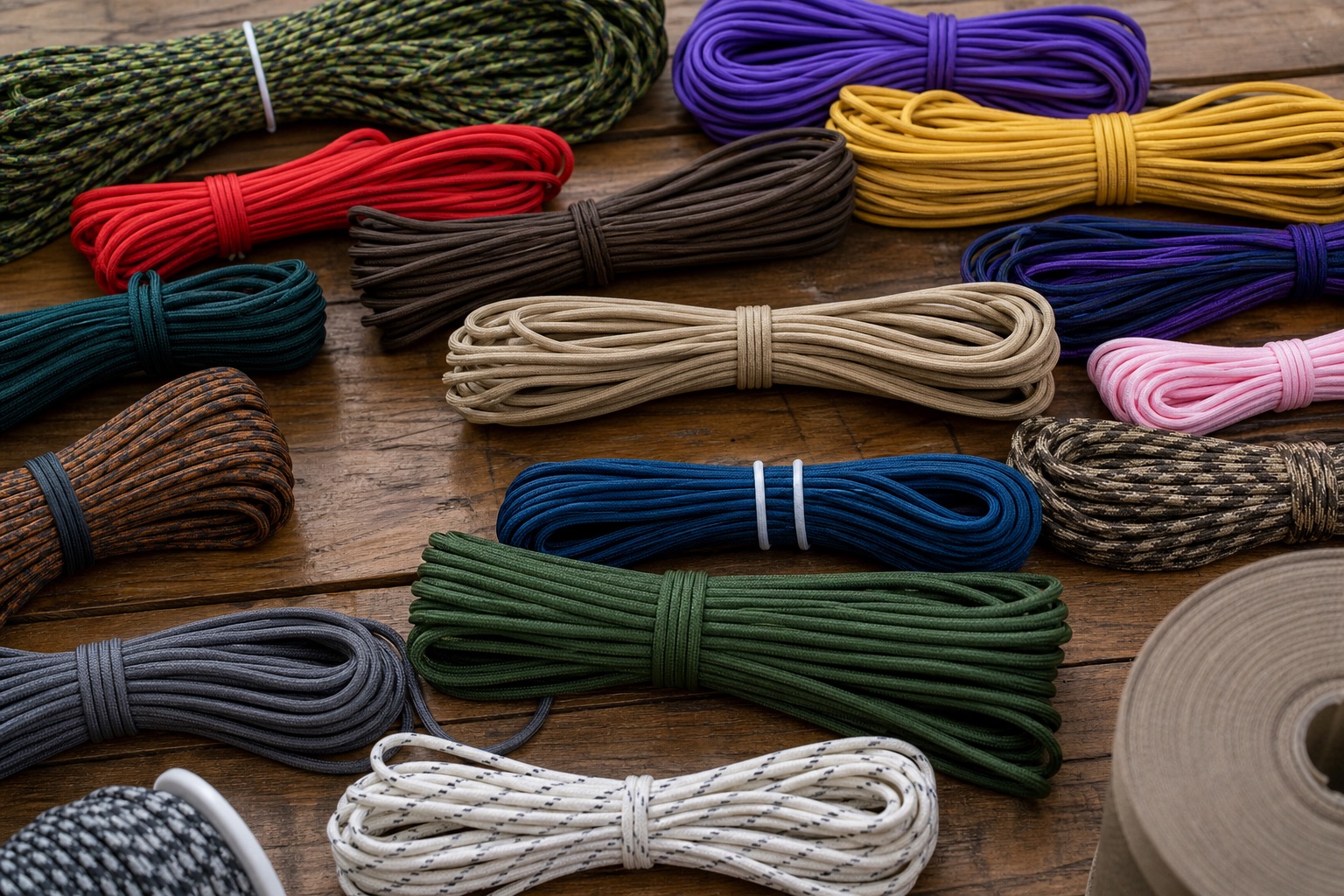
The paracord family at a glance
| Type | Diameter | Min. strength | Core strands | Best for |
|---|---|---|---|---|
| Micro / nano | ~0.75–1.5 mm | 35–100 lb | none or 1 | lacing, zipper pulls, decorative detail |
| Type I | ~1.6 mm | 95–100 lb | 1 | thin lanyards, buddy lines, sewing core |
| Type II | ~2.4 mm | 400 lb | 4–7 | light kits, koozies, small handles |
| Type III (550) | ~3.2 mm | 550 lb | 7 (2–3 ply) | the default: bracelets, ridgelines, lanyards |
| Type IV (750) | ~4 mm | 750 lb | 11 (2 ply) | heavy rigs, straps, suspension work |
| Battle cord / mega | ~5–6 mm | 1000+ lb | 100+ filaments | heavy-duty straps and slings |
Why Type III conquered the world
Three millimetres is a sweet spot: thick enough to grip and to hold a friction weave like the cobra stitch, thin enough that a bracelet carries three to five metres of emergency cordage. Seven two-ply core strands give you fourteen lengths of strong thread once gutted, the classic field arithmetic that made 550 the survival bracelet standard. If you are stocking one spool, stock this one; our buyer's guide covers what to check before you pay.
Mil-spec versus commercial: the honest answer
True mil-spec Type III (spec label PIA-C-5040 Type III) is manufactured to a defence standard: verified 550 lb breaking strength, a sheath woven from a minimum of 32 independent nylon filaments in each core strand bundle, and batch traceability. It costs roughly double the commercial equivalent.
Commercial-spec 550 from a reputable maker is, in practice, excellent: genuine nylon sheath and core, honest strength within 10–15 percent of label. The problems live at the bottom of the market: cords with polyester sheaths, fewer core strands, or strength labels copied from the mil-spec sheet. Red flags: no strand count stated, "550" printed without units, cord that flattens when pinched, sheath that slides off the core. Burn-test a cut end: nylon melts into a hard amber bead; a crumbly or self-extinguishing ash suggests blended fibre.
Bench test: gut an inch of your cord. Seven strands, each twisting into two or three plies, sheath densely woven and hard to push a fingernail through, you are holding honest 550. Three slack strands in a loose sleeve is craft cord, fine for a keychain, not for a ridgeline.
Choosing by mission
- Bracelets, lanyards, keychains: Type III. The weave density and the buckle ecosystem (see our buckle guide) are built around 3–4 mm cord.
- Zippers, thread, detail work: micro cord or gutted core strands. Learn to join offcuts and nothing is wasted.
- Ridgelines, tarp guy runs, packs: Type III minimum; Type IV if you rig big tarps or hang gear in bear country.
- Dog collars, heavy straps: two passes of Type III in a wide weave, or battle cord for large dogs.
- Where stretch hurts (ridgelines under tension): pre-tension your cord or choose the fishtail deployment style that takes up slack.
- Colours no spool sells: white Type III nylon takes dye readily, and makers who want a pattern rather than a flat shade end up borrowing from textile practice, where resist dye techniques compared sets out how the resist methods differ before you commit a metre of cord to a dyebath.
The one-line summary
Buy honest Type III for 95 percent of life, keep a spool of micro cord for the small stuff, and reach for Type IV or battle cord only when the load genuinely grows. For everything else, the deciding factor is not strength class but knot skill, which is exactly what the rest of this site teaches.
Type III, the 550 cord, is the diameter most makers reach for, but the same spec logic applies to the rest of the kit you carry. Diameter and strength ratings only help if the rest of your load is chosen the same way, by category and material rather than by look. A short related note on the page Paracord types & sizes explained points to a breakdown of gear that earns its place, covering golf kit by category and material: shoes, bags, clothing. Read it alongside the type table when you are deciding what a cord has to hold.
Cord diameter is only half the decision. A 550 paracord listed as 4 mm can measure closer to 4.5 mm once the sheath relaxes, and that difference changes which buckle, cord lock or lanyard hole it will pass through. The same logic of measuring before you buy applies to gear you use daily, and Paracord Central covers it in a separate guide on measuring before you buy for home coffee brewing, where roast, grind and ratios depend on weighing the dose rather than guessing it. Buy one hank, cut a short length, and check the fit against the hardware you already own before ordering in bulk.
Type classification is not the only place where cordage and metal meet. The same habit of reading a spec sheet, checking diameter, strength and material, applies to blades. A page on fibre and metal specs covers European sword typology, forge practice and care, and it treats measurements the way this page treats cord: as a starting point, not a verdict. If you already compare Type III against Type II by break strength, that method transfers. Read the sword page alongside this one when a project involves both rope and steel.
Type designations tell you what a cord will hold, not what it is made of, and the same gap shows up in clothing. A shell listed as nylon, polyester or a blend behaves differently in abrasion, drying time and how it takes dye, which matters when a garment is expected to survive repairs and repeated washing. The page on Everyday Clothes: Fibres, Fewer Pieces, Care treats that side of the question, including how to read a fibre label before choosing a fibre for a piece meant to last. Read it alongside the type table when a project mixes cord and fabric.