Reference · planning
How much paracord do you need? Length and thickness by project
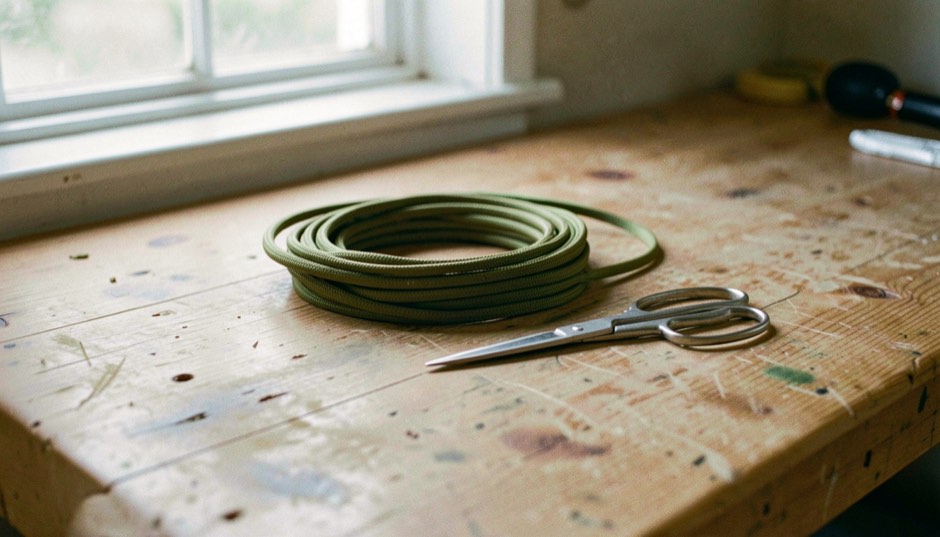
For a cobra bracelet, plan about one foot of Type III 550 paracord for every inch of finished bracelet. That is the rule printed in a bracelet handout from Colorado State University Extension, where an 8-inch wrist calls for 8 feet of cord. A king cobra takes roughly twice as much. For any other weave, and for your own hands, weave a test inch and measure what it used before you cut the full length.
Length and thickness are the two numbers that decide whether a project finishes neatly at the buckle or stops two rows short of it. This page covers both, with the arithmetic written out so you can check every figure against a tape measure.
Where does the one-foot-per-inch rule come from?
It is a maker's rule of thumb, not a standard. The clearest published version sits in the bracelet handout from the Garfield County office of Colorado State University Extension: one inch of bracelet length needs about one foot of cord, so an 8-inch wrist means measuring out 8 feet. The same sheet lists the rest of the kit as 1/8 inch paracord, a 3/4 inch plastic side-release buckle, a ruler, scissors and a lighter.
In metric the rule is tidier than it looks. A foot is 30.48 cm and an inch is 2.54 cm, so the ratio is exactly twelve: twelve centimetres of cord for every centimetre of cobra weave. A 20 cm bracelet therefore needs about 2.4 m of cord before any allowance for the ends.
The ratio is high because a cobra row is a complete knot tied around a doubled core. Each working end crosses the front or the back of the core and passes through a loop on the far side, so most of the cord goes into wrapping, not into running along the bracelet. That is also why the figure moves as soon as the weave, the core or the cord changes.
How do you work out the finished length first?
The cord figure is only as good as the length you multiply it by. For a bracelet, the Colorado State handout sets the distance between the two buckle halves, not counting the male prongs, at the wrist measurement plus one inch. Wrap a strip of cord or a soft tape around the wrist, add the inch, and that is your woven length. The cobra bracelet tutorial shows how to adjust that allowance for a snug or a loose fit.
Other projects need the same discipline. On a lanyard only the spine is woven, while the loop and the clip end add their own length, so measure each part separately. On a collar, the woven length follows the neck measurement and the hardware, which is why a collar build fixes the buckle and the ring before any cord is cut.
Then add the ends. The handout trims each tail to about half an inch before melting it, and the cord also has to pass through the buckle at both ends. Several online bracelet calculators add about a foot for the tails and the loops, so an 8-inch cobra is usually cut at around 9 feet.
Why does each weave use a different amount of cord?
A king cobra is a second cobra pass woven back over the first, so it uses roughly double: about two feet of cord per inch, or 16 feet for an 8-inch bracelet before the tails. Because the second pass wraps a core that is now a finished bracelet, some makers find it needs a little more than double, so cut generously the first time.
Flat weaves are less settled. We have not found two published fishtail figures that agree: bracelet calculators place it anywhere from well under the cobra rate to above it. Tension, the brand of cord and how tightly you pack each row all shift the result, which is the honest reason to measure your own ratio rather than trust a single number.
| Finished length (buckle to buckle) | Cobra, at 1 ft per inch | Cobra cut length, with 1 ft for ends | King cobra, at about 2 ft per inch |
|---|---|---|---|
| 6 in (15 cm) | 6 ft (1.8 m) | 7 ft (2.1 m) | 12 ft (3.7 m) |
| 7 in (18 cm) | 7 ft (2.1 m) | 8 ft (2.4 m) | 14 ft (4.3 m) |
| 8 in (20 cm) | 8 ft (2.4 m) | 9 ft (2.7 m) | 16 ft (4.9 m) |
| 9 in (23 cm) | 9 ft (2.7 m) | 10 ft (3.0 m) | 18 ft (5.5 m) |
The king cobra column is the woven figure only; add the same foot for ends, or a little more while you learn the weave.
How do you measure your own ratio with a test piece?
A ten-minute test replaces every rule of thumb with a number that belongs to your hands, your cord and your weave. Do it once per weave and per cord type, and write the result on the spool.
- Cut an offcut of the exact cord you plan to use, about 4 feet (1.2 m), and note its length to the centimetre.
- Set up a short core, 2 inches (5 cm) between two split rings or buckle halves, folded exactly as you would for the real piece.
- Weave the full 2 inches at your normal tension, the way you will weave the finished project.
- Measure the two tails left over and subtract them from the starting length. That is the cord the piece consumed.
- Divide by the woven length. Two feet used over two inches is the classic one foot per inch.
A short test slightly overstates the ratio, because the loops at each end are a bigger share of a small piece. That error is on the safe side: a bracelet cut from it will finish with a little spare cord rather than a little short.
Which thickness of paracord suits which project?
Paracord types come from the US military specification MIL-C-5040H, which was inactivated in 1997 but remains the reference sellers quote. It defines the types by minimum breaking strength and core yarns: Type I at 95 lb, Type II at 400 lb, Type III at 550 lb with seven to nine core yarns, and Type IV at 750 lb with eleven. It does not set an overall diameter for the cord.
That gap shows up on the bench. The Colorado State handout calls 550 cord 1/8 inch, about 3.2 mm, while a retailer lists one US maker's 550 at 4 mm, or 5/32 inch, with a note that the figure is nominal and changes under load. Almost a millimetre separates two honest descriptions of the same type, and a millimetre decides whether a weave passes through a buckle slot or a bead.
For choosing, the short version is the one in our paracord types and sizes reference: Type III for bracelets, lanyards, keychains and collars, micro cord or gutted core strands for zipper pulls and lacing, and Type IV for heavy straps and rigging. Whenever you change type, run the test piece again. A thicker cord changes both how much each knot uses and how many knots fit in an inch, and the result is not worth guessing.
How much should you buy, and how many projects does a hank make?
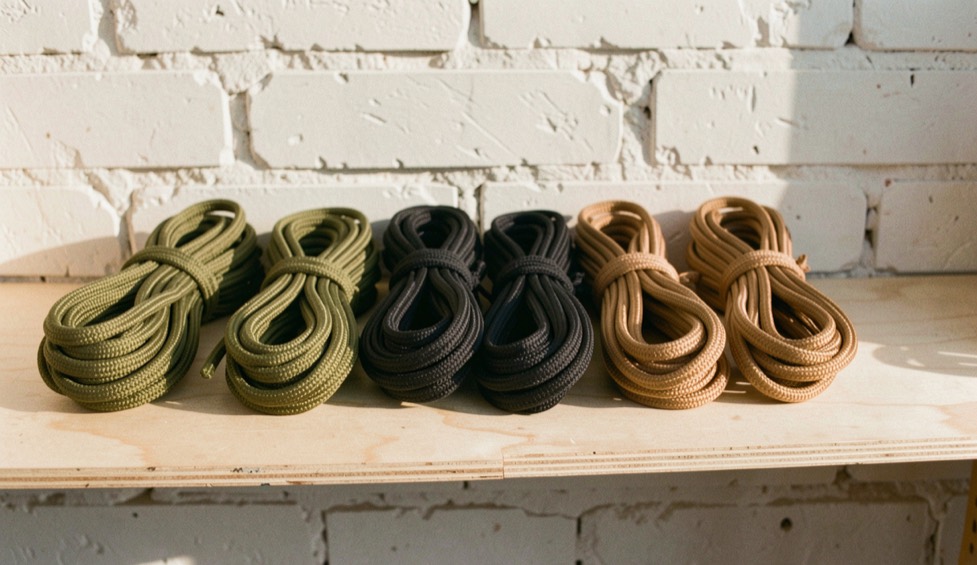
Retail 550 cord is most often sold in 100-foot hanks, which is 30.48 m, and in 1,000-foot spools for people who weave every week. The arithmetic for a hank is simple once the cut lengths are fixed. At 9 feet per 8-inch cobra bracelet, 100 feet gives eleven bracelets with a foot to spare. At about 17 feet per 8-inch king cobra, ends included, it gives five, with 15 feet left over for a lanyard or a few zipper pulls.
Keep every offcut longer than about two feet. Short lengths become keychains, tracers and test pieces, and two offcuts of the same cord can be joined with a melt splice or a double fisherman's bend when a project runs out of cord halfway. A splice is easier to hide at the start of a weave than in the middle, which is one more reason to cut long.
How do you make sure you always have paracord with you?
By wearing or clipping on the length you are likely to need, not by owning a spool at home. At the rule of thumb, an 8-inch cobra bracelet carries about 8 feet, or 2.4 m, of cord: enough to replace a bootlace or lash a broken strap. A king cobra roughly doubles that. A woven lanyard on the keys or a zipper pull on the pack adds a little more, and a 50-foot hank in the pack covers the bigger jobs, such as a tarp ridgeline.
Plan the worn length the same way you plan a project. Decide what the cord must do, work out how much that takes, then pick the weave that carries it. Then test it once: unravel your own bracelet at home and measure what comes out, because a length on the wrist only helps if you know what it is.
Questions readers ask
How much paracord do I need for an 8-inch bracelet?
About 8 feet (2.4 m) for a cobra weave by the one-foot-per-inch rule, cut at around 9 feet to cover the tails and the buckle loops. A king cobra of the same length takes about 16 feet for the weave, so cut 17 feet or more.
How many bracelets can I make from 100 feet of paracord?
About eleven 8-inch cobra bracelets at 9 feet each, or five king cobras at about 17 feet each. Smaller wrists and a tight, consistent tension can stretch that a little; mistakes and learning rows will shrink it.
Is it better to cut paracord too long or too short?
Too long, every time. Trimming wastes a few inches, while running short means starting again or hiding a splice in the weave. Once your own test piece tells you your real ratio, you can cut closer to it with confidence.
Sources
- DIY: Paracord Survival Bracelet, Garfield County office of Colorado State University Extension (cord per inch of bracelet, buckle-to-buckle length, kit list).
- Parachute cord, Wikipedia (MIL-C-5040H types, strengths, core yarns, status and the absence of a diameter requirement).