Knot guide · friction
How to tie a prusik knot
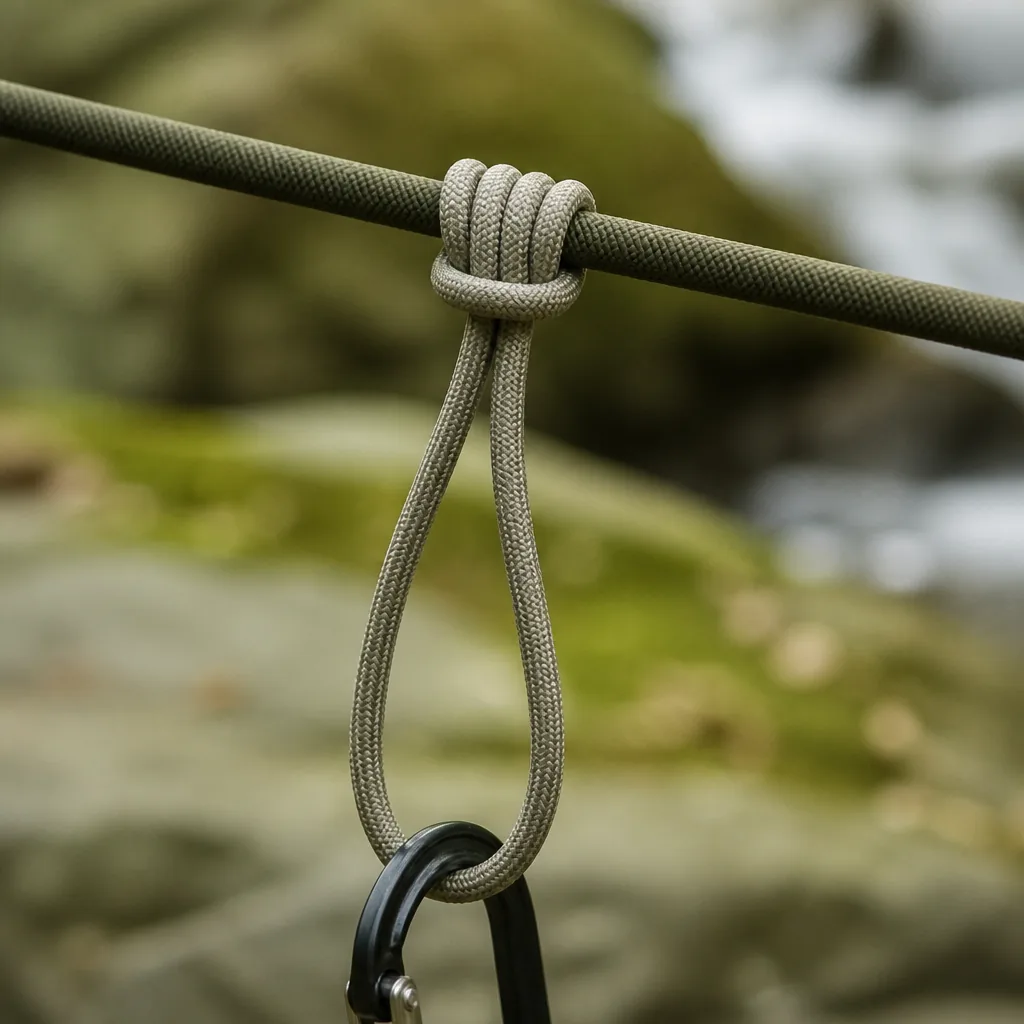
Of all the knots in the paracord repertoire, the prusik is the one with real mechanics. It is a friction hitch: a loop of cord wrapped around a host line so that loading the tail squeezes the wraps tight against the host, the harder the pull, the harder it grips. Release the load, push the wraps with a fingertip, and the same knot glides anywhere along the line. Mountaineers trust it with their lives; campers will find it the most useful knot on any tarp rig.
Why it works
Capstan friction: each wrap multiplies the grip of the previous one. Two wraps around a 10 mm host hold a light load; three wraps hold a person; four are available for icy or slick lines. The prusik grips in both directions along the host, which distinguishes it from one-way hitches and makes it reversible, lower a load, then re-position and lower again.
Tying it, step by step
Make the loop
Form a closed loop of paracord about 60–90 cm around, joining the ends with a secure bend (a double fisherman's, or a melted and whipped splice). The loop's joining knot will travel with the prusik, keep it small.
Wrap three times
Pass the loop behind the host line and wrap it around the host three full turns, stacking the wraps neatly side by side, not bunched, not overlapping. The loop should be roughly half the diameter of the host line; if your host is 3 mm paracord itself, use micro cord for the prusik.
Dress the wraps
Hold the host line and slide the wraps together so they touch. Smooth, parallel wraps are the difference between a prusik that bites and one that slips under load.
Load it
Clip a carabiner through the loop or tie your guyline to the tail and pull. The wraps cinch onto the host instantly. To move it, take the load off and push the wraps from either end, they will slide freely.
Field applications
- Adjustable tarp guyouts: prusik on the ridgeline, guyline to the stake: re-tension wet nylon in one push, no re-tying.
- Lantern and gear hangers, a prusik loop slides to height on the ridgeline and holds a swinging load without sliding down.
- Progress capture in hauling, the prusik acts as a ratchet in a piggyback haul system.
- Double-loop ladder, series of prusiks on a fixed line make slip-proof footholds for river crossings.
Safety line: a prusik grips nylon-on-nylon, but paracord is not rated climbing rope, and neither is this a climbing lesson. For life-safety rigging use rated cord, rated hosts and real instruction. Around camp, the prusik's genius is convenience: a knot that holds like a clamp and moves like a zipper.
Troubleshooting
Slips under load: add a wrap, or use a thinner loop cord: friction scales with the mismatch between diameters. Will not slide when slackened: your wraps are crossed; re-dress them. Frozen or wet host: go to four wraps. And if the loop cord is the same diameter as the host, nothing will save you; downsize the prusik cord or use a lanyard-knot-based fixed loop on a braided host instead.
The prusik's cousins
Three siblings cover the jobs the classic prusik does less well. The klemheist is tied with a single strand (no loop needed) and grips beautifully on icy or wet hosts while releasing more easily. The autoblock wraps around the host inside a carabiner, the standard choice for backup friction on a rappel line, and equally handy as a sliding tensioner on a clothesline. The blake hitch grips one-way and slides when tended, which arborists favour for moving up a fixed line. Around camp you will reach for the classic prusik nine times in ten, but knowing the klemheist alone (tied from the tail of your guyline with no extra cord) has rescued more sagging tarps than any gadget sold for the purpose.
A note on the name
The knot carries the name of Dr Karl Prusik, an Austrian mountaineer and music professor who published the wrapping technique in 1931: a reminder that the most useful hardware in the mountains turned out to be knowledge, folded cord and friction. Ninety years later the same three wraps still anchor tarp ridgelines, hang bear bags and ratchet loads on trailers. Few knots so small do so much work.
Two habits that travel
The prusik teaches two things at once: a mechanism is worth understanding before you use it, and nothing gets loaded before it is checked. Both apply well outside camp.
- le mode Titan de Battlefield 2142, a French dissection of a game mode built like a machine, for readers who take the same pleasure in seeing how a system holds together.
- vergunning van de Kansspelautoriteit controleren, a Dutch page on verifying a licence before trusting it: the same reflex as testing a hitch before you hang anything from it.
A prusik holds because the wraps grip the host line, and that same logic shows up wherever cord meets moving water. Anglers who fish the McCloud and Upper Sacramento deal with hatches, pocket water and shifting flows, and the cord work around a drift boat or a wading staff follows the same rules: wrap, load, release. A short page on Paracord Central covers river knots and rigs for that stretch of water, including how flow changes the way a hitch seats. Read it after this one if you want the field version of the same mechanics.
The prusik holds because the wraps bite the host line, and the same logic of reading a surface applies to moving water. A trout river is not uniform: seams, pools and current edges tell you where the flow changes speed and where a fish will sit. Anglers who learn to read those lines before they rig a rod waste less time on dead water. Paracord Central covers this in its page on reading seams and pools, alongside its knot and cord work. The habit transfers: look at the structure first, then choose the wraps, the tension and the length of cord you actually need.